

Print that works with your production line
An attractive label is only useful if it can be applied properly. Printed roll labels need to match both the container and the labelling equipment. PAQVARO coordinates print and roll requirements so a quote reflects how you will actually use the labels.
Hand application or a labelling line
A roll used by hand and a roll feeding an automatic applicator may need different configurations. Send the equipment specification or an approved current roll, along with container details and line conditions. We confirm the proposed roll configuration before production.
Core size and maximum roll diameter
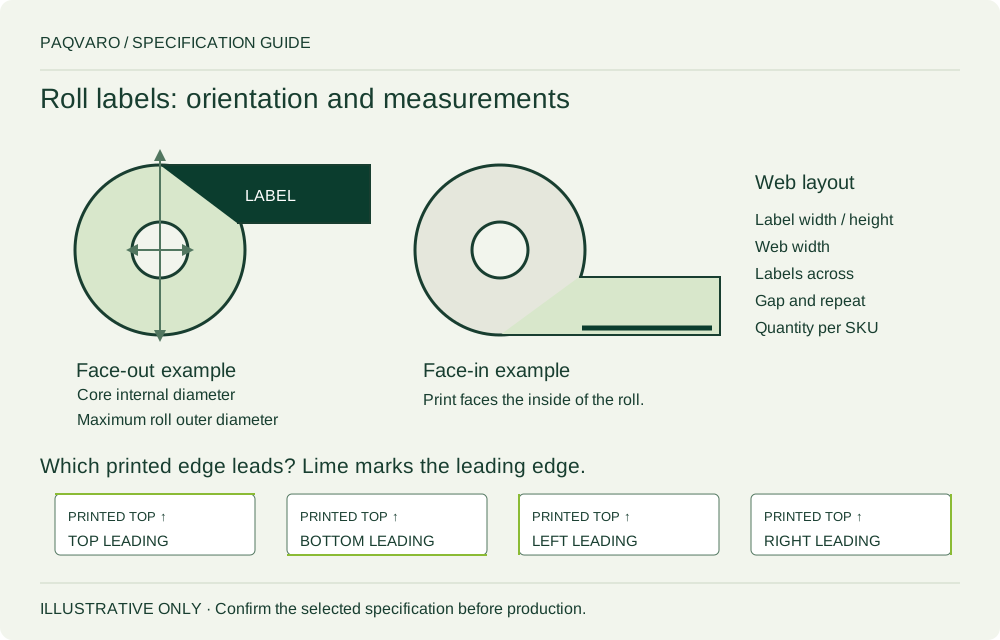
State the core’s internal diameter, the maximum outside diameter the machine accepts, and any preferred labels per roll. These are separate measurements. We ask for your actual requirements rather than list unverified standard core sizes or promise compatibility with a particular machine.
Winding direction and presentation
Confirm whether labels face into or out of the roll, and which printed edge leads as the web unwinds. An applicator may describe the same orientation using its own numbering system. Use the labelled illustration as a communication aid and obtain the machine or operator’s confirmation.
Labels across, gap and repeat
Include finished label width and height, web width, number of labels across, the gap between repeats and any liner constraints. Repeat is the pitch from one label position to the next, including the gap. Supply the machine drawing if you are unsure which dimensions it needs.
Substrates, adhesives and operating conditions
The container surface, curvature, application temperature and later exposure influence the material and adhesive choice. Describe moisture, oils, refrigeration or abrasion where relevant. We confirm an available construction and any appropriate compatibility trial before making performance claims.
SKU control and repeat production
Provide quantities for each design, not just a total roll count. Agree the artwork revision, roll orientation and specification for every SKU. Reorders should identify the approved reference and any changes to the container, applicator or operating conditions.
Artwork and pre-production checks
Use the agreed cutter guide and identify finishes, barcodes and variable information. Review both the printed proof and the roll configuration: artwork approval alone does not confirm winding, core or roll diameter. Send your existing roll specification for a practical comparison.
A useful specification resource
Communicating roll orientation
Use the printed top, bottom, left and right edges to describe presentation. The drawings are illustrative, not a universal winding-number standard. Confirm the final orientation with your applicator operator.
| Decision | Information to confirm | Why it matters |
|---|---|---|
| Winding | Face-in or face-out; printed edge leading | Match the drawing to the applicator feed direction. |
| Roll geometry | Core internal diameter; maximum outside diameter | Distinguish the opening in the core from the full roll. |
| Web layout | Label W × H; web width; labels across; gap/repeat | Send the machine drawing or an approved current specification. |
| Production | Quantity per SKU; labels per roll if required | Confirm version and configuration before each repeat run. |
Your questions, answered
How do I identify winding direction?
Confirm face-in or face-out plus the printed edge that must lead off the roll. Ask the applicator operator to check the diagram; do not assume winding numbers are universal.
What core and roll size can you supply?
Send the core internal diameter and maximum roll outside diameter required by your equipment. We confirm available production options against those requirements in the quotation.
What does label repeat mean?
It is the pitch between consecutive label positions along the web, including the gap. Share the machine drawing so finished label size, gap and repeat are not confused.
Can you match our current rolls?
Share the approved specification or a sample, artwork versions and quantities. We assess material and configuration differences and confirm compatibility requirements before production.