
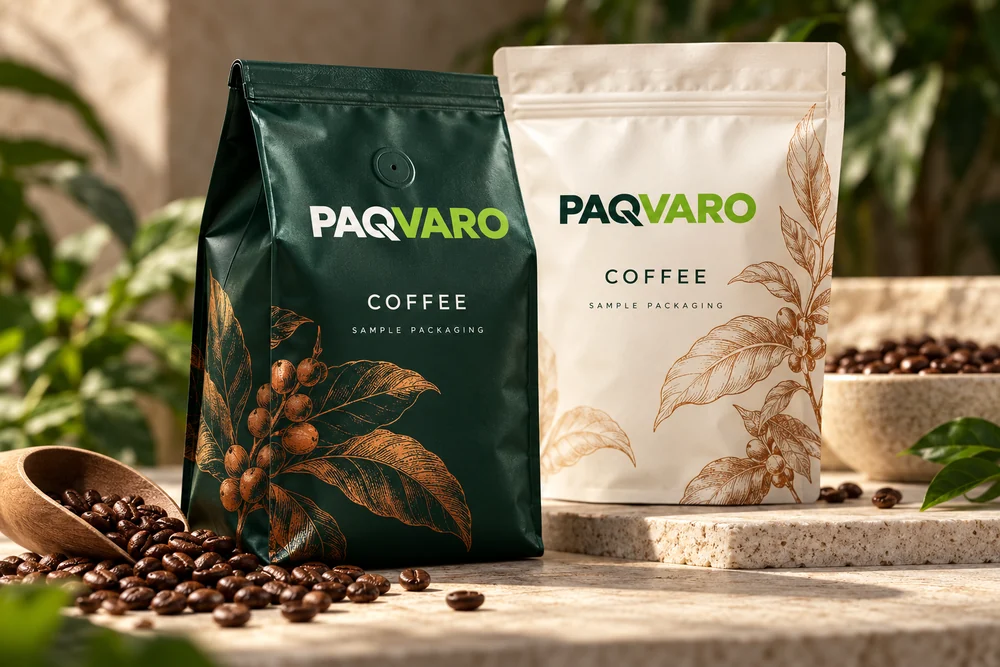
Packaging that fits the way you roast and sell
Retail bags, online orders and regular wholesale supply can place different demands on coffee packaging. We start with your contents, fill weight, filling process and order pattern, then assess suitable printed packaging options through our supplier network.
Coffee bag formats and shelf presentation
Describe whether you sell whole beans or ground coffee, the filled weight and how the bag will be displayed or dispatched. Stand-up, flat and other bag constructions offer different presentation and filling characteristics. We confirm a suitable available format against the brief rather than assume every construction is interchangeable.
An opening base gusset helps a stand-up bag present on a shelf, but the filled bag should be checked for balance. A flat pouch can suit a smaller or hanging pack and does not offer the same standing footprint. Keep the retail display brief separate from the protection needed for dispatch, including any outer packaging.
Fill weight is a starting point, not a bag size
Bean size, roast, grind and packing method affect how much space the product occupies. Share a current pack, empty dimensions or a product sample where appropriate. Agree the proposed pack size and any fill trial before approving the artwork or production specification.
A bag described as 250g or 500g is not a universal capacity. Whole beans and different grinds occupy different volumes; the pack also needs headspace and a clean top sealing area. Record empty width, height and the gusset measurement convention, then test your actual coffee on the intended filling equipment.
Freshness, barriers and the filling process
Explain the interval between roasting and packing, the filling/sealing method, storage and distribution conditions, and the shelf-life target. These are inputs to specification review. We do not assign a freshness claim or barrier performance without evidence for the exact quoted construction.
Oxygen ingress, moisture and light are separate considerations. A metallised-looking film is not evidence of a particular barrier performance. Ask for construction-specific information and assess it alongside roast-to-pack timing, distribution and your own shelf-life validation. Keep coffee particles out of the seal and confirm the sealant works with the equipment settings.
Valves and closures
Tell us whether your existing bag has a valve, zipper or other closure and what the feature needs to achieve. Valve type, location, availability and suitability must be confirmed with the chosen bag construction and process. A diagram shows where a feature might sit; it does not certify performance.
A one-way degassing valve is intended to let roasting gases escape while limiting air entry through the valve. It does not replace a suitable film or correctly formed seals, and it is not a freshness certification. Ground coffee and whole beans may need different assessments of degassing and packing practice. A resealable zipper helps after opening; the initial heat seal above it remains a separate part of the brief.
Different blends, formats and artwork versions
Provide quantities by blend, roast, grind and pack size, with a clear artwork version for each SKU. Note seasonal releases and which products are likely to reorder together. This helps us compare production options and keep specifications aligned across the range.
Separate permanent print from information which changes frequently, such as batch or roast details, and tell us how that information will be applied. Short seasonal runs and regular wholesale repeats can have different cost drivers. Quantities and viable options are agreed per design rather than inferred from another supplier's advertised minimum.
Artwork, sample checks and repeat supply
Use the agreed cutter guide and confirm the valve/closure positions before artwork sign-off. Agree an appropriate sample or fill check, including its scope and cost. For repeat orders, confirm the approved specification, artwork revision, quantities per blend and required delivery date.
General printed-pouch optionsReview your existing coffee bag
A useful specification resource
The coffee packaging brief
An illustrative checklist for a roaster’s specification discussion. Feature placement, capacity and material performance must be confirmed for the selected pack.
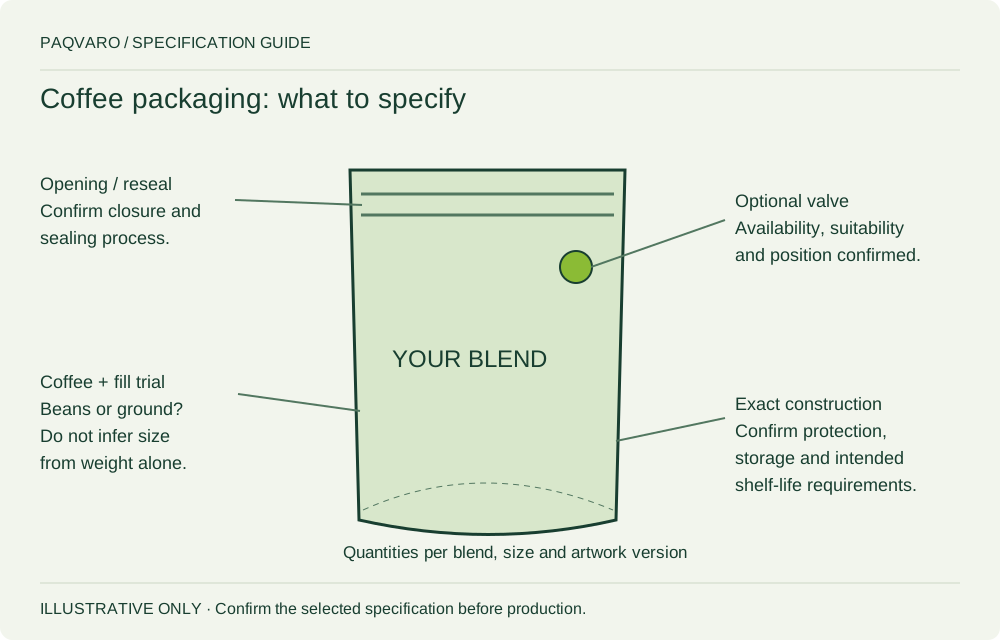
| Decision | Information to confirm | Why it matters |
|---|---|---|
| Contents and fill | Beans or ground; roast/grind; filled weight | Use the actual product to establish fit. |
| Product protection | Storage, distribution and shelf-life target | Request evidence for the proposed material construction. |
| Valve and closure | Existing features, function and preferred position | Confirm suitability and available options before artwork. |
| Range and repeat supply | Quantity per blend, size and artwork version | Plan approvals and repeat specifications at SKU level. |
Your questions, answered
Which size bag will hold my coffee?
Fill weight alone does not establish fit. Share your coffee type, an existing pack or proposed dimensions so the size and any fill trial can be agreed.
Can you supply a valve bag?
Include the valve requirement in the brief. We confirm available valve options, position and suitability for the selected construction before quoting a specification.
Can quantities be split across blends?
Send quantities for each blend and artwork version. The quotation will set out the proposed production route and any applicable minimums.
Can you review our current coffee packaging?
Yes. Send the specification, quantities, order pattern and any features you need to retain. We identify material or construction differences when comparing options.