
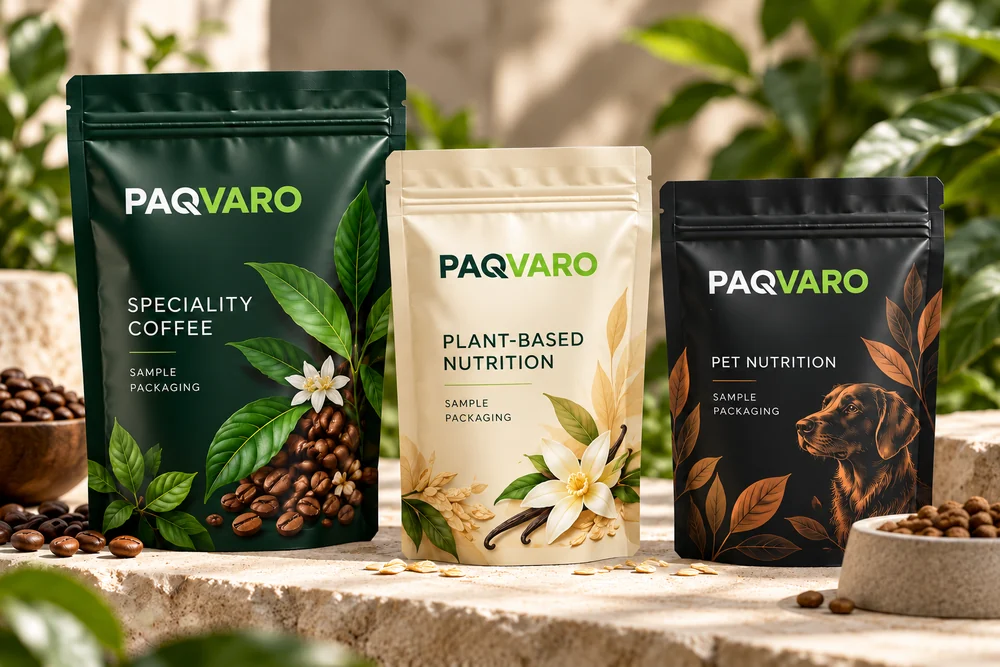
Good food packaging starts with the right questions
Snacks, powders, seasonings and other food products can have very different packaging needs. We help you put the product and operating conditions first, then assess a suitable format, construction and print approach for commercial supply.
Choose the pack around the food and process
Tell us what the food is, whether packaging has direct or indirect contact, and how it is filled, stored and distributed. Dry snacks, seasonings and chilled products have different requirements. We assess available formats against the actual brief rather than describe all packaging as universally food safe.
A dry powder, an oily seasoning and a crisp snack can need different moisture, oxygen, grease and light protection. A pouch format appropriate for one product is not evidence that it suits another. Describe processing conditions, including any hot filling, freezing or other demanding use, so an appropriate production route can be assessed before a capability is promised.
Pouches, labels and product cartons
Pouches may form the primary pack, while labels and cartons may support a separate container. Describe the complete packaging system and the role each component performs. The selection guide helps identify the additional information needed for each format.
Stand-up gussets can aid display; flat pouches or small sachets may suit portions and samples. A portion pack has less printable area and may not reseal. A label on a jar relies on the primary container for protection, while an outer carton has a different structural role. Check the whole system rather than assigning every function to the printed outer component.
Filling, storage and product protection
Include the filling process and temperature where relevant, sealing equipment, storage conditions and shelf-life target. Barrier and seal performance must be supported for the exact construction. Do not infer shelf life from material appearance or a generic description.
Provide empty width × height × gusset, the measurement convention and the actual fill weight. A 500g powder and 500g snack can occupy very different volumes, so use a sample fill test to check headspace, opening and stability. Automated filling also needs suitable nozzle access and consistent sealing conditions; contamination in the seal area can compromise the pack.
Documentation for the selected intended use
Tell us which technical or customer documentation you require. Food-contact suitability and any declaration must relate to the supplied construction and intended conditions of use. We identify what needs confirmation before the specification is agreed; the website does not certify an unselected pack.
A construction can include a printable outer film, a barrier layer and an inner sealing layer. Metallised or other laminates are options to assess, not proof of food-contact suitability, shelf life or recyclability. Request documentation for the exact materials, food type, contact conditions and intended use. Confirm any change of material before treating a repeat order as equivalent.
Flavours, formulations and artwork
List quantities for each flavour, size and artwork version. The brand owner should supply and approve product wording, ingredients, allergen information and other required content. Keep artwork revisions clear through proofing and repeat orders.
Use the approved dieline and keep required wording inside the safe area, away from folds, closures and opening features. Confirm bleed and any white-ink areas for clear or metallised films. Full-colour digital printing and multiple artworks can be assessed for the selected route; quantity and proof approval remain specific to each SKU.
Packaging supply across a range
Coordinate the pouch, label and carton brief so dimensions and versions work together. Coffee roasters can use the coffee page for valve and fill-weight considerations; technical roll requirements sit on the roll-label page.
A useful specification resource
Food-packaging selection checklist
A briefing aid, not a declaration of food-contact compliance. Confirm the exact construction and intended conditions before ordering.
| Decision | Information to confirm | Why it matters |
|---|---|---|
| Primary pouch | Food, fill/seal process, storage and protection | Review the selected construction and supporting documentation. |
| Container label | Container surface, application and exposure | Assess adhesive/material compatibility and roll requirements. |
| Product carton | Primary container, dimensions and distribution | Confirm whether contact is indirect and review structural fit. |
| Whole range | SKU quantities, artwork and documentation | Keep product wording and specification approvals traceable. |
Your questions, answered
Is every packaging material suitable for food contact?
No blanket assumption should be made. Suitability and supporting documentation must be confirmed for the selected construction, intended food and conditions of use.
What do you need to assess a food pouch?
Product details, filling/sealing process, storage, dimensions, fill weight, quantity per SKU and any required technical documentation.
Can you coordinate several flavours?
Yes, provide each SKU, quantity and approved artwork version. Keep product and regulatory content under the brand owner’s approval process.