
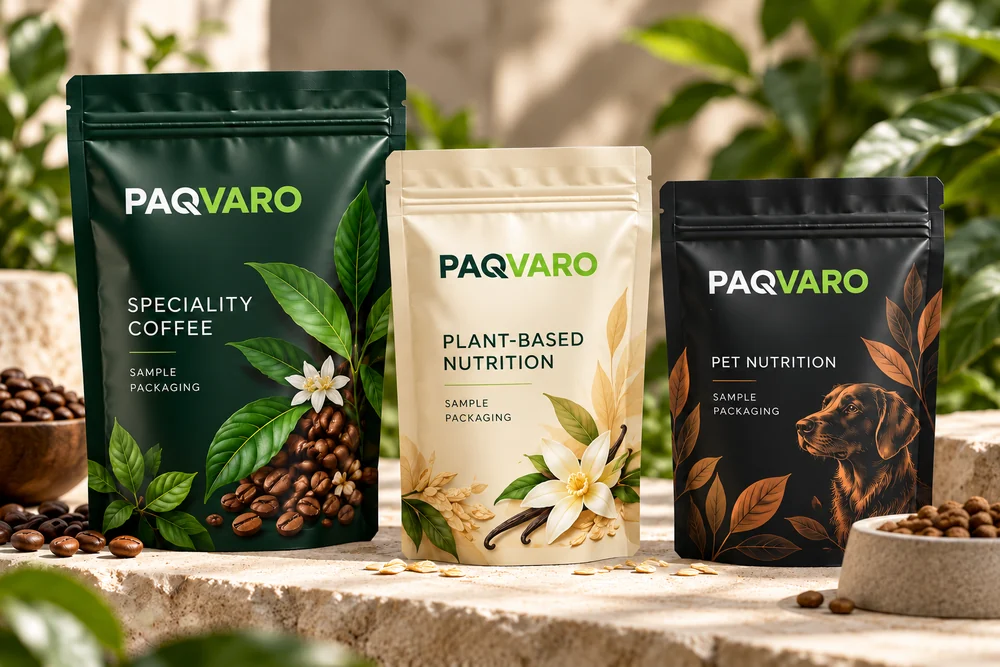
A better starting point for your next pouch
A pouch needs to do more than look good. It needs to suit the contents, protect them through distribution and work with the way you fill and seal it. PAQVARO supplies custom printed pouches through an established supplier network, with specification and production managed through one point of contact.
Choose a format around the product
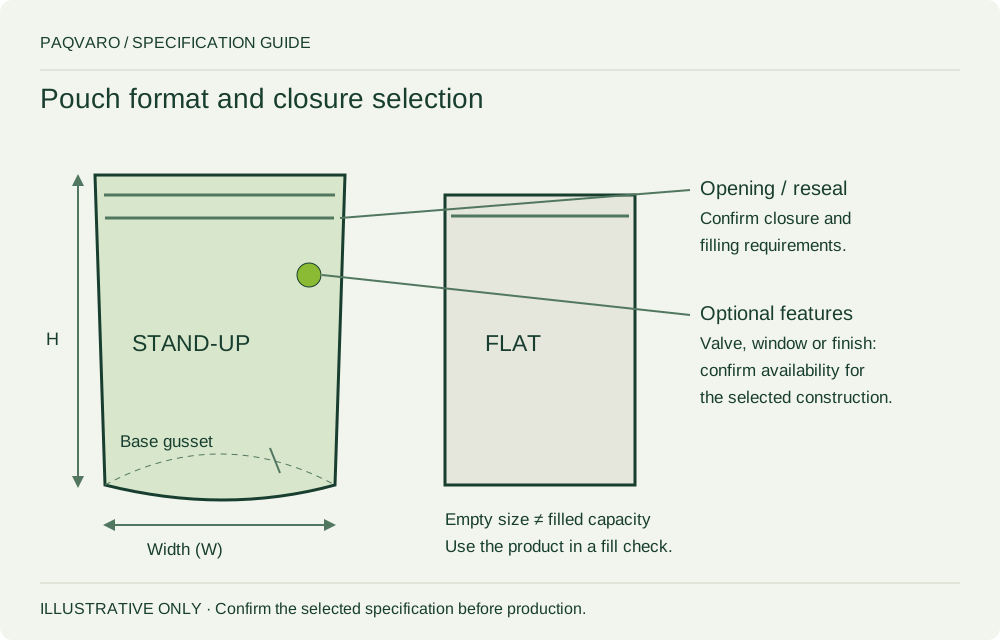
A stand-up base can help a pouch present upright; a flat pouch may suit a compact pack or single portion. Start with the contents, filled weight, shelf presentation and filling process. Dimensions describe the empty pack: a fill trial is a better guide to usable capacity than a weight-to-size assumption.
A stand-up pouch has a folded base gusset which opens as it fills, creating a footprint for display. Stability depends on the gusset, pack proportions and actual contents; a very light or uneven fill may still need support. Flat pouches have no expanding base and usually lie flat or hang for display. Small sachets suit measured portions or samples, but have less space for product information and are often opened once rather than resealed. Confirm the available construction and sealing arrangement for your chosen route.
Specify empty width × height × gusset in millimetres and confirm whether the supplier measures the gusset as a folded depth or its full opened dimension. Allow usable headspace below the closure and the required top sealing area. A nominal 250g or 500g description is only a guide for a particular product: powders, beans and light snacks have different bulk densities. A sample fill trial checks volume, appearance, closure access and stability together.
Materials and product protection
Tell us whether the contents are dry, oily, aromatic or moisture-sensitive, together with storage conditions and the intended shelf-life target. We review available constructions against that brief. Barrier, sealing, food-contact and recycling statements must relate to the exact selected construction and its supporting documentation.
Flexible films can combine several functions: an outer layer carries print and protects the surface, a barrier layer limits transmission, and an inner sealant forms the heat seal. Depending on the production route, options may include clear plastics, metallised films or foil-containing laminates. Polyethylene or polypropylene can be used as sealing layers in suitable structures. These are examples of construction principles, not interchangeable specifications or a promise that every combination is available.
Oxygen protection and moisture protection are different requirements. Oils, aromas, light sensitivity and storage temperature also affect selection. Ask for the actual layer construction and evidence relevant to your intended use; a silver appearance does not establish a barrier value. Mono-material and mixed-material structures can differ in sealing and protection. Any recycling statement needs evidence for the complete pack, including closures, and the collection route available to the customer.
Closures, openings and filling
A resealable zipper, tear opening, window or valve changes the specification. Describe how the pack will be opened, resealed, filled and sealed, including equipment constraints. We confirm which features can be combined in the quoted format before artwork is prepared.
A zipper supports repeat opening but does not replace the initial heat seal. A tear notch helps the consumer open the sealed top; its position must work with the zipper and safe print area. Euro slots or hanging holes need an agreed position and enough material to support the filled pack without compromising the seal. Rounded corners change the cut shape. These details should be included before the dieline is approved.
A transparent window can show the contents, but changes to the opaque or light-protective area may affect the protection brief. Matt, gloss and soft-touch finishes have different handling and appearance characteristics; availability depends on the selected print and converting route. Degassing valves are considered for suitable coffee applications. Confirm which features can be combined rather than treating the list as a universal catalogue.
For machine filling, share the opening width, nozzle clearance, dosing method and sealing equipment. Sealant compatibility, temperature, pressure and dwell time need to match the filling process. Product trapped in the seal area, particularly powders or oils, can undermine sealing; assess the actual product and process in a trial.
Food, coffee and seasoning ranges
A roaster, spice brand and nutrition business have different product and handling requirements. Include the product type and filling conditions in your brief, rather than choosing a material from appearance alone. Use our coffee and food pages for the additional information relevant to those products.
Packaging for pet food and treats
For dry foods and treats, include contents, fill weight, handling conditions and the intended route to market. We can assess pouch options through our established supplier network. Any claims about protection or suitability are confirmed for the selected specification.
Quantities across designs and repeat orders
List each flavour, formulation and size, with the quantity needed for each design. Tell us which packs reorder together and whether demand changes through the year. Viable production quantities and timings depend on format and specification; they are confirmed in the quotation, without a universal minimum.
A short run and a larger repeat order may suit different production routes. Unit cost depends on pouch format, dimensions, material construction, printing, finishes, converting features and quantity per artwork version. Combining designs does not automatically remove a minimum per SKU. We compare the available options against the complete brief, including any setup or sampling costs and the order pattern.
For a current specification review, supply an empty sample or technical sheet, existing dimensions, construction if known, order quantities and essential features. For repeats, quote the approved pack specification and artwork revision. Changes in product, filling equipment or artwork should trigger a review rather than an assumption that the previous approval still covers them.
Artwork, sampling and approval
Work to the agreed cutter guide and artwork instructions for the quoted pack. Identify barcodes, variable information and finishes before proofing. We agree whether an existing sample, material swatch or structural/printed sample is appropriate, what it demonstrates, and any cost before proceeding. Approve the specification and artwork before production.
Full-colour digital printing may suit multiple designs and smaller production quantities where available for the selected format. The quotation confirms the print route. Prepare artwork on the current supplier dieline: bleed extends beyond the cut edge, while the safe area keeps text and barcodes clear of cuts, folds, zippers and notches. Follow the specified bleed and safe-area dimensions rather than a universal template.
For clear or metallised films, discuss any white-ink layer and the intended transparent or metallic areas before proofing. Agree colour references, finish layers and a separate proof for each SKU; a screen preview does not prove the colour of the final printed material. The brand owner must approve wording and barcode content, and check barcode readability on the intended pack.
A stock pouch helps assess general structure; a swatch shows material or finish; a printed sample addresses a different question. None automatically establishes food-contact suitability or shelf life. Agree which trial is needed, what it proves, and any cost before approving production. Retain the approved specification, proof and reference sample where agreed for repeat comparisons.
A useful specification resource
Pouch format and closure selection
Use this comparison to prepare a brief. These are selection considerations, not a catalogue of guaranteed combinations. We confirm the final format, construction and available features in your quotation.
| Decision | Information to confirm | Why it matters |
|---|---|---|
| Stand-up format | Shelf presentation, base gusset and filled stability | Check the actual product fill and intended display. |
| Flat format | Pack proportions, portion size and sealing area | Confirm the space needed for contents and filling. |
| Resealable opening | How often the consumer opens and closes the pack | Confirm closure availability and compatibility with the chosen construction. |
| Valve or window | Product need, position and effect on construction | Include the requirement in the brief; availability must be confirmed. |
| Material and finish | Protection, appearance, sealing and intended use | Approve one documented specification rather than assuming materials perform alike. |
Your questions, answered
How do I choose pouch dimensions?
Share a current pack or your product, fill weight and proposed format. Dimensions and a product fill trial help establish fit; the same stated weight can occupy different volumes.
Can one order include several designs?
Send the quantity for each artwork version and pack size. We assess suitable production routes and confirm any minimum quantities in the quote.
Can you quote a short run?
Yes, send the brief for assessment. Availability and viable quantities vary by format, material and print requirements; we confirm options rather than promise a blanket minimum.
Can I review a sample first?
Ask which sample stage suits your decision. A stock sample, material swatch and printed production sample demonstrate different things; availability, scope and cost are agreed before proceeding.